
The Last Invasion
Fishguard, Foxgloves, and the Myth We Prefer

This is a tale of David and Goliath victory of little Wales against the territorial ambitions of revolutionary France. But was it victory or farce?
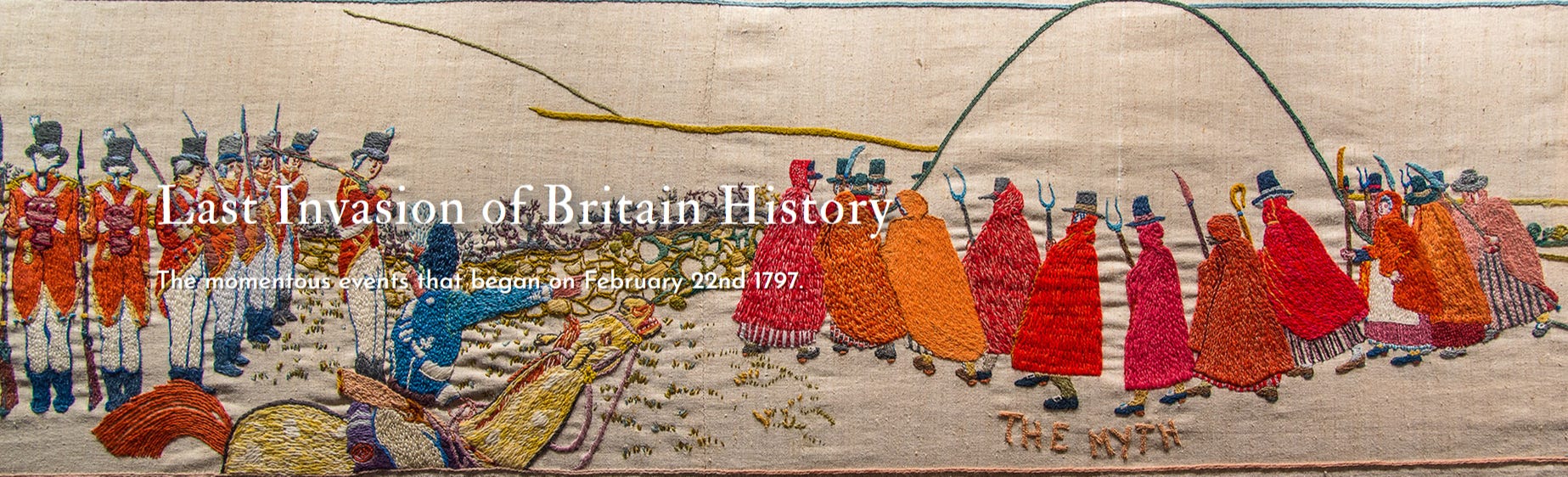
The story goes that on February 22nd 1797, in Fishguard, Welsh women were watching from the hills, anticipating an invasion. Wrapped up against the icy February sea winds, the 1400 men on four French ships had been spotted in the Irish Sea heading in their direction. The question was, would they land? Was this a repeat of the failed French invasion of Bantry Bay three weeks earlier in support of the Society of United Irishmen?
Revolution was in the air in Europe. In Paris ‘le Directoire,’ the executive of the French revolutionary government, wanted to foment unrest in Britain too.
The Society of Irishmen, a banned, largely clandestine republican organization was preparing for an armed rebellion against British rule and if it hadn’t been for the typical British weather, they would have added French know-how to boiling Irish passions. As it was, that uprising was doomed to failure, for now.
Now the French had turned their sights on a softer target; They were intent on starting a Welsh revolution, and for the ladies of Pembrokeshire, this would be a show worth seeing. The women wanted a grandstand seat.
Dressed in typical red Welsh woollen shawls and black beaver hats, they looked down on beaches and inlets for miles around. As the myth has it, the women on the hilltops were mistaken for Welsh Guards in their famous red coats. Later generations would portray them wearing “Welsh hats” of much later Victorian imagination, and the reluctant soldiers were unnerved. Their hats were just typical black beaver hats, common at that time,
The Legion Noir as they were dubbed, didn’t sail brazenly into Fishguard harbour under waiting guns; chosing a quieter cove at Carregwastad nearby, and came ashore as huge winter storms were brewing. The navy delivered the flotilla, turned tail and sailed away, deserting the now isolated army. it was an error. Only one of the four returned to France, one was captured by the British and renamed HMS Fisgard, the other two foundered in the storms.
On land there was much sign of resistance, but with the rough sea at their back and the supposed British army looking down from the heights. Marauding through the coastal farms and cottages, wine was liberated, discipline frayed. Within days, the expedition collapsed and soon surrendered.
One Welsh defender, Jemima Nicholas, was reputed to have marched twelve, admittedly inebriated, Legionnaires into surrender on the point of her pitchfork. Whatever the truth of that, she was certainly there; she signed as a witness to the surrender
It’s a wonderful tale. It’s just not the whole one.
And possibly not the most interesting one either.
By 1797, France had grasped something important. You did not need to conquer London to unsettle Britain. You could harass, distract, or even force redeployment. This tiny and final intrusion reminded the remote parliament that the margins mattered.
Wales, with its long coastline and distance from Westminster, made sense.
Not as a punchline, but as a pressure point.
The landing itself was badly executed and poorly supplied. There’s no need to romanticise it. But incompetence on the ground does not mean stupidity in intent.
Wales was not incidental.
The last invasion was a message, a lever. and because someone believed a few roughnecks landing on the soft underbelly of a mighty nation would unleash the British Revolution, which Paris was sure must be bubbling beneath the surface. It was, but for the English, the violence of Madam Guillotine was a step too extreem to embrace.
What Survives
High above Fishguard harbour stands the old Napoleonic fort. Cannons still face a sea that has not delivered an army in over two centuries.
Stand there in June, and you will not see soldiers.
You will see foxgloves standing guard.
Purple spires nodding in a salt breeze.
Gorse blazing gold.
Thrift and campion spilling over grey granite cliffs.
Ancient fortifucations turned into a museum to the folly of war nested in the beauty of a wildflower sanctuary.
In Beware the Quiet Man, Ollie sits on one of those ancient guns before leaving home in 1965. The fort is no longer defending against invasion. It is witnessing a departure.
The remnants of those days live on, but not as smoke and musket fire. They live as iron sunk into grass. As story.
And as thread.
Ask any Welsh woman who has waited up for her husband to come home from the pub, Welsh men know how to embroider a good story. But Welsh women are not so bad at that either.
The women of Pembrokeshire (assisted by a few men) have made this fracas in an underpopulated corner of Wales into an epic to rival the Battle of Hastings.
The Battle of Fishguard is memorialised in the Last Invasion Tapestry. A mammoth undertaking work 30.4 meters long and 53 centimetres high, stitched deliberately in the style of the Bayeux Tapestry and housed in Fishguard Library.
The Bayeux Tapestry glorifies conquest, a nation’s survival against Imperial might in coloured yarn. Their needles amplify the dignity and stoicism of Welsh women for generations to come.
The Real Story
The French failed to conquer Wales in 1797, as did the Romans, The Anglo Saxons and the Normans. Driving the indigenous population, the Wēalas, the Anglo-Saxon word that was used to describe the indigenous Brythonic-speaking population of our island, into the hills.
The Welsh, the remnants of the original population of the British Isles, have often stood at the edge of other people’s calculations.
And yet they and their language remain.
Fishguard fort no longer guards against invasion. It stands in memory of a culture and pride in its language and traditions against the efforts of successive waves of would-be conquerors who somehow always remained Y Saesneg – The Saxons - to the Welsh.
The Question is ,,,
Do we tell the story of Fishguard because it was funny?
Or because it reminds us that the margins matter. That we matter?